John Bobby Creative.
Free field guide
A free field guide for video editors

The 9 story first principles that make your editing invisible, so viewers feel the story.

Get The Invisible Edit free: 28 pages and 9 chapters on what separates editors who decorate from editors who direct. Enter your name and email below and I'll send the PDF straight to your inbox.

  • A hundred year old experiment with one expressionless face that proves the emotion comes from your cut.
  • Piling on effects shows a client you worked hard, right? Wrong. Chapter two explains what it actually tells the person watching.
  • The four honest reasons to make a cut (there are only four). If none of them is true, don't cut yet.
  • Where the best moment in your project is hiding: it's often the clip you were about to delete.
Enter your name and email to get the guide.

I won't spam you or share your details, and you can unsubscribe any time.

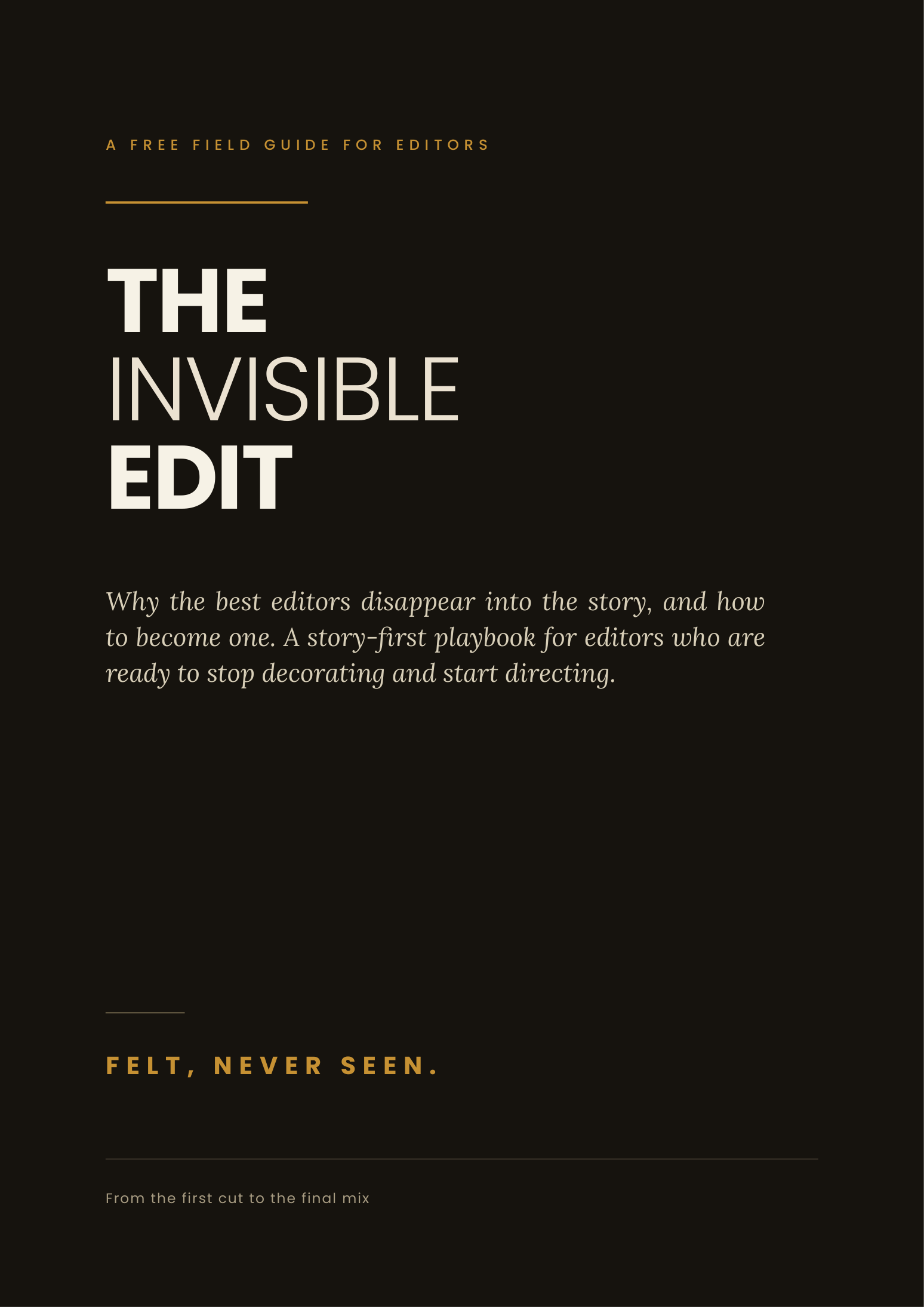
Cover of The Invisible Edit, a free field guide for editors

28 pages  ·  9 chapters  ·  PDF


Somewhere we lost the plot

You didn't fall in love with editing because of a transition pack.

You fell in love because a scene or a montage hit you in the chest and wouldn't let go, and you watched it again thinking: I want to do that.

Then look at what the craft turned into: graphics flying in every three seconds, a whoosh on every subtitle, and sound design that pops so hard it stops sounding real. The cuts come so fast that nothing gets to land, let alone breathe.

And everyone is doing it. That look became the default a long time ago, so it no longer sets anyone apart, and the market for it is saturated. When every editor competes on who can decorate hardest, decoration is worth nothing.

The editors who get paid the most skip all of that and put their effort into the thing you first fell for: letting a story unfold. This guide is how they think.

No one walks out of a great film talking about the cuts. They talk about how it made them feel. That is the whole job. From chapter one

What's inside

Nine chapters, from the first cut to the final mix.

There are no effect tutorials or preset packs in here. It's the way of thinking that separates editors who decorate from editors who direct, and it's written to be read with a project open.

01

The truth we forgot

Editing is storytelling, and the proof is a hundred years old. The experiment every editor should know cold.

02

The decoration habit

Why adding more makes the work look smaller, and what the best paying clients are actually buying instead.

03

Every cut needs a reason

Motivated cuts, the four honest reasons to cut, and the one word filter that fixes a restless edit.

04

Pacing is emotion

People think pacing means speed. It's how you make a viewer breathe, and there are four levers that control it.

05

What they hear is what they feel

The three audio layers in priority order, where every sound goes and why, plus J-cuts and L-cuts.

06

Choosing music that fits

Pick music by the feeling first and the genre second. Beds versus builds, and the exact method for building to a reveal.

07

The order you work in

Make the story work naked, then dress it. The full pass order, and why polish early hides problems.

08

The human moments

The clip you were about to delete is often the best one. Mining outtakes, and b-roll that earns its place.

09

Train your eye and your ear

You are building taste, and taste is what compounds. Ends with the rule "steal structure, not effects."


Who this is for

Written for editors who want the reasoning behind their cuts.

This is for you if

  • You edit video and you care more about moving people than impressing other editors.
  • You already know your software, but your work still feels a step below the videos you admire.
  • You are tired of competing on effects in a feed where everyone has the same effects.
  • You want the reasoning behind each choice. Another list of techniques won't give you that.

This is not for you if

  • You want a transition pack or a preset library.
  • You are looking for software tutorials or keyboard shortcuts.
  • You think the goal of an edit is for viewers to notice the editing.

Who wrote this

Four years in the timeline, most of it long form.

Most of it was long form YouTube for creators in travel and martial arts, plus promotional videos for dental clinics and a run of short ads. The short form work mainly taught me what not to carry into longer pieces.

A thirty second ad and a twenty minute video are different crafts. You can hold someone for thirty seconds on density alone. You can't do that for twenty minutes; you have to earn the time instead, and almost everything in this guide came from learning that the slow way.

I also spent a good stretch of those years doing exactly what chapter two describes: adding more, because adding felt like working. This guide is the shorter version of working that out.

Nobody sat me down and explained that restraint was a skill rather than laziness. Why this guide exists

Get the guide

Let the story breathe. Get the guide free.

It's 28 pages and 9 chapters, and it costs nothing. Enter your name and email and it'll land in your inbox.

Enter your name and email to get the guide.

I won't spam you or share your details, and you can unsubscribe any time.